Buying Wholesale Clothing in Bangkok for a US Shop: What Changes Above 2,500 Dollars
2,500 dollars is the line. A boutique owner who fills two cartons at Pratunam, Bobae or Platinum for 1,800 dollars sends an informal entry into the USA. The same owner with 6,000 dollars of stock sends a formal one, and a formal entry needs a bond, a named importer of record and a manufacturer code for every supplier in the box. None of that changes the duty on a dress. It changes who signs for it and what happens when a paper is missing. Dragon Courier ships from Bangkok to the USA duty and tax inclusive, 10 kg for 4,731 THB and 20 kg for 8,157 THB on the Standard service, price list of 3 August 2026.
When does a clothing shipment to the USA need a formal entry?
When the merchandise in the shipment is worth more than 2,500 dollars. Below that figure customs accepts an informal entry, the simplified route used for small parcels. The regulation lists what qualifies:
"(a) Shipments of merchandise not exceeding $2,500 in value (except for articles valued in excess of $250 classified in Chapter 99, Subchapters III and IV, HTSUS);"
Source: 19 CFR 143.21, Merchandise eligible for informal entry, Electronic Code of Federal Regulations.
A claim repeated on many broker websites is that textiles always need a formal entry, or that the line for clothing is 250 dollars. The text above does not say that. The 250 dollar exception covers goods under safeguard measures in Chapter 99, not clothing as a category. Garments from Thailand follow the same 2,500 dollar line as everything else.
Informal entry | Formal entry | |
|---|---|---|
Value of the shipment | Up to 2,500 dollars | Above 2,500 dollars |
Customs bond | Not required | Required, single entry or continuous |
Importer of record | Usually handled by the carrier | Must be the owner, the purchaser or a licensed broker acting for them |
Merchandise processing fee | A small flat fee | 0.3464 percent of the value, minimum 33.58 dollars, maximum 651.50 dollars |
Manufacturer code on textiles | Required on commercial shipments | Required, and the entry can be rejected without it |
Duty on the garments | Same rate | Same rate |
The fee figures are those in force since 1 October 2025. Customs and Border Protection adjusts the limits once a year and leaves the percentage alone:
"Only the limitation is increasing; the ad valorem rate of 0.3464 percent remains the same."
Source: Customs User Fees To Be Adjusted for Inflation in Fiscal Year 2026, CBP Dec. 25-10, Federal Register, 23 July 2025.
Who is the importer of record on a wholesale order?
The US buyer, or a licensed customs broker the buyer appoints. The Bangkok wholesaler cannot be. The statute limits the role to three kinds of party:
"the required documentation or information shall be filed or electronically transmitted either by the owner or purchaser of the merchandise or, when appropriately designated by the owner, purchaser, or consignee of the merchandise, a person holding a valid license under section 1641 of this title."
Source: 19 U.S.C. 1484, Entry of merchandise.
The importer of record is the party customs holds responsible for the value declared, the classification and the duty. On a formal entry that party also stands behind a bond:
"merchandise shall not be released from Customs custody at the time Customs receives the entry documentation or the entry summary documentation ... unless a single entry or continuous bond on Customs Form 301 ... has been filed."
Source: 19 CFR 142.4, Bond requirements.
A shop that imports a few times a year buys a single entry bond each time through its broker. A shop that imports monthly takes a continuous bond that covers twelve months of entries. Dragon Courier offers an importer of record service and clears customs on the US route itself, so a buyer without a broker should state the value of the order when asking for the quote and ask who will stand as importer on that shipment.
What is the MID, and why does a market stall matter to US customs?
The MID is a code built from the name and address of the factory that made the garment, and US customs requires it on every commercial clothing shipment. Most buyers meet it for the first time when an entry is held.
"All commercial importations of textile or apparel products must identify on CBP Form 3461, or its electronic equivalent, (Entry/Immediate Delivery) and CBP Form 7501, or its electronic equivalent, (Entry Summary) ... the manufacturer of such products through a manufacturer identification code (MID) constructed from the name and address of the entity performing the origin-conferring operations"
"If an entry filed for such merchandise fails to include the MID properly constructed from the name and address of the manufacturer, the Center director may reject the entry or take other appropriate action."
Source: 19 CFR 102.23, Origin and Manufacturer Identification.
This is where buying in a Bangkok market differs from ordering from a factory. The stall at Platinum is a trader. The code wants the business that cut and sewed the garment, which may be a workshop in Bobae, a factory in Samut Sakhon or, for some stock, a factory in another country entirely. A buyer should ask each supplier two questions before paying: who made this, and where. The answers go on the commercial invoice, line by line. Garments made outside Thailand and sold in a Thai market keep their real origin, and the duty and any additional country tariff follow that origin, not the city where the carton was packed.
What must be on the labels before the cartons leave Bangkok?
Three things: the country of origin, the fibre content and the name or number of a responsible US business. Customs wants the first. The Federal Trade Commission wants all three before the garment is sold.
"every article of foreign origin (or its container) imported into the United States shall be marked in a conspicuous place as legibly, indelibly, and permanently as the nature of the article (or container) will permit, in such manner as to indicate to an ultimate purchaser in the United States the English name of the country of origin of the article, at the time of importation"
Source: 19 CFR 134.11, Country of origin marking required.
"Textile labels must identify fiber content, country of origin and either the company name or the Registered Identification Number (RN) of the manufacturer, importer or another firm marketing, distributing or otherwise handling the product."
"RNs are not issued to businesses outside of the U.S."
Source: Threading Your Way Through the Labeling Requirements Under the Textile and Wool Acts, Federal Trade Commission.
Market stock in Bangkok is often unlabelled or carries a size tag only. The origin label has to be on the garment when it arrives, so it is sewn in Thailand. Many wholesalers in Pratunam will sew a buyer's own woven label for a few baht a piece if asked at the time of the order, and the label can carry the fibre content and the shop's name at the same time. The FTC registers RN numbers for US firms free of charge, and the same guidance notes that "An RN is not required in order to do business in the U.S."
What is different about children's clothing?
Children's clothing needs a certificate based on laboratory testing, and that requirement falls on the importer. It is the rule a small shop is most likely to miss, because nothing at the market mentions it.
"Section 14 of the CPSA, as codified in 16 CFR part 1110, requires domestic manufacturers and importers of children's products to certify in a written Children's Product Certificate (CPC), based on test results from a third-party, CPSC-accepted laboratory, that their children's product(s) comply with applicable children's product safety rules."
Source: Children's Product Certificate, U.S. Consumer Product Safety Commission.
A children's product is one made for a child of 12 or younger. It also needs a permanent tracking label with the maker or importer's name, the place and date of production and a batch number. Sleepwear is stricter again. Pyjamas, nightgowns and robes up to size 6X fall under the flammability standard in 16 CFR 1615, with a parallel standard for larger children's sizes. All clothing, adult included, must pass the general flammability standard, whose stated purpose is "prohibiting the use of any dangerously flammable clothing textiles". Sheer rayon and brushed fabrics are the usual failures.
A buyer who cannot arrange testing should leave children's lines out of a first order.
Can an order be split into smaller boxes to stay under the line?
Shipping an order in instalments is allowed. Splitting one purchase to dodge the formal entry is not, and the word that separates the two is in the regulation: "Any bona fide installment valued at not over $2,500 ... may be entered on an informal entry". A shop that buys 2,000 dollars of stock in March and 2,000 in May has two real shipments. One 7,000 dollar invoice cut into three cartons sent on the same day is one purchase. A value written down to fit is worse. The penalty statute covers any entry made by means of a statement that is "material and false", and sets the ceiling for fraud at "the domestic value of the merchandise".
Source: 19 CFR 141.82(d) and 19 U.S.C. 1592.
Duty itself is unchanged by the type of entry. Each garment pays the rate for its fibre and construction, and the low value exemption for commercial parcels has been suspended since 29 August 2025. On top of the tariff schedule sits an additional country rate set by executive order. The order published in the Federal Register on 6 August 2025 lists Thailand at 19 percent, effective the following day, and later orders have adjusted the scheme, so the rate is checked on the date of entry. On a duty and tax inclusive booking those charges are inside the shipping price.
About Dragon Courier
Dragon Courier is a Bangkok courier, family owned, with more than 30 years in logistics in Thailand and more than 20,000 shipments a month to over 200 destinations. On the USA route it runs its own service to the destination and clears customs itself, then a US carrier delivers the final leg. Prices are duty and tax inclusive with no hidden fees, and the same price list applies to every customer.
Weight | Standard | Express |
|---|---|---|
5 kg | 2,729 | 3,548 |
10 kg | 4,731 | 5,814 |
20 kg | 8,157 | 9,622 |
Thai Baht, duty and tax included, price list of 3 August 2026. Cartons are charged on actual weight or on dimensions, whichever is greater, and clothing in a large carton often prices on dimensions. Duty rates garment by garment are in the guide on shipping garments from Thailand to the USA, and the way the wholesale markets pack and hand over cartons is in the guide on shipping from Pratunam.
Contacts and drop-off
Office +66 2656 9019, LINE and WhatsApp at +66 6-5937-0812, or info@dragoncourier.com. Drop-off runs until 17:00, Monday to Saturday, at 217/3 Crystal Garden Building, 3rd floor, Sukhumvit Soi 4, and a collection can be arranged from the market. Answers to common questions are on the FAQ page. Does every supplier on the invoice have a factory name next to it?
---META---
{
"metaTitle": "Wholesale Clothing From Bangkok to the USA: Formal Entry",
"metaDescription": "Above 2,500 dollars a clothing shipment to the USA needs a bond, an importer of record and a manufacturer code. What a US shop buying in Bangkok should prepare.",
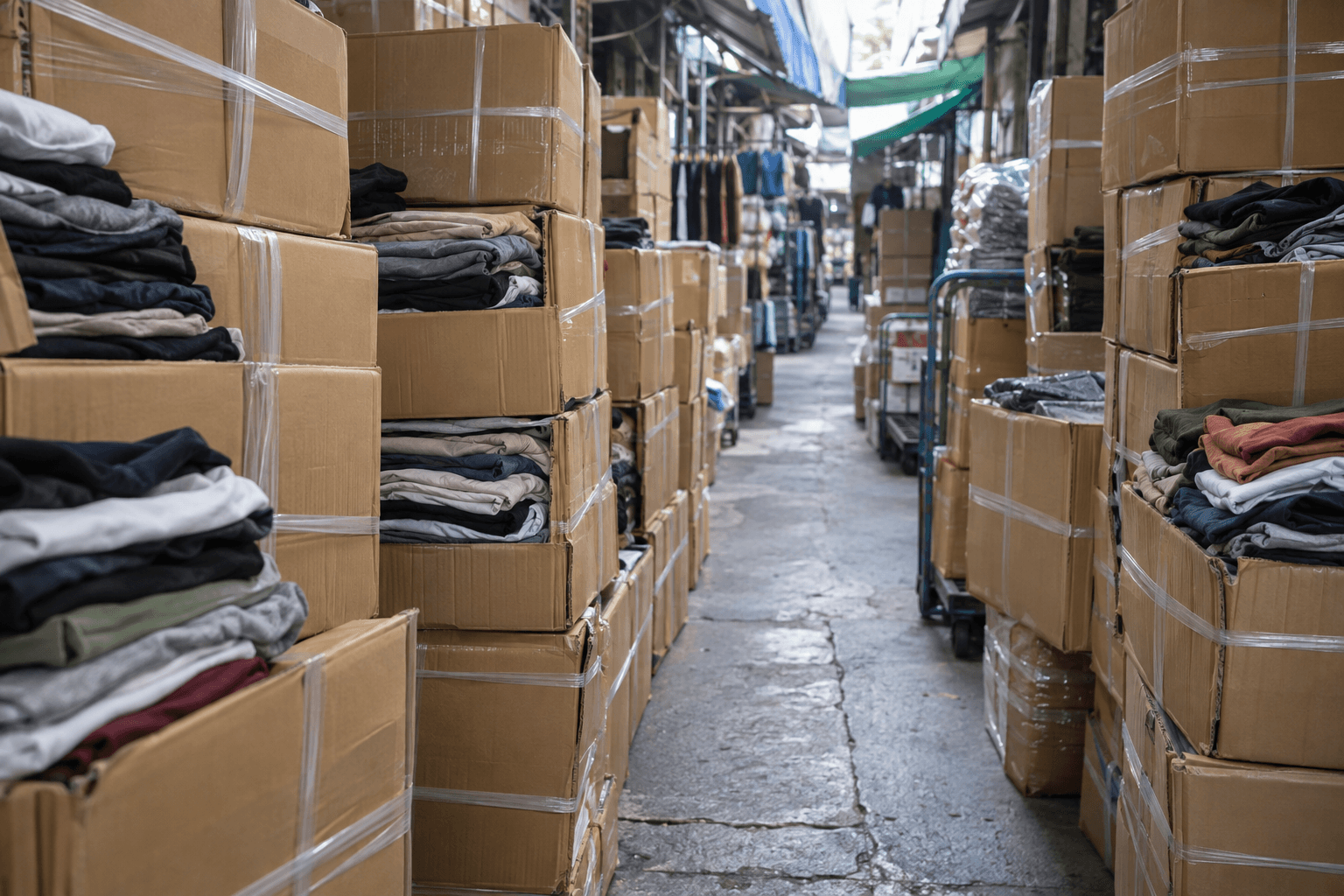
"heroAlt": "Stacked cartons of folded garments tied with plastic strapping in a narrow aisle of a Bangkok wholesale clothing market",
"keyword": "wholesale clothing from bangkok to usa",
"keywords2": "import clothing from thailand to usa, pratunam wholesale shipping to usa, formal entry clothing import",
"related": ["/destinations/usa", "/guides/shipping-garments-from-thailand-to-usa", "/guides/shipping-from-pratunam-to-the-philippines-and-uae", "/guides/shipping-cost-from-thailand-to-usa"]
}
Does Dragon Courier collect from the market?
Yes. A specific pickup date and time can be arranged, and cartons can also be dropped at the Bangkok office on Sukhumvit Soi 4 until 17:00, Monday to Saturday. Buyers who shop at several stalls usually have each stall deliver to one point and book a single collection.
Is there a limit on how much can be sent?
No. There is no limit on the number of packages or the volume. A single box cannot be unreasonably heavy to handle, so a large order travels as several cartons on one booking.
What does Dragon Courier need for a quote?
The contents of the package and the receiver's name, address and contact number. For a wholesale order add the total value and the number of cartons with their dimensions, because the value decides the type of US entry.
Can the cartons be insured?
Yes. Insurance covers loss at the value the sender declares. Damage is not covered on normal shipments, and clothing is low risk for damage if the cartons are lined with a plastic bag against moisture.
Is payment on delivery possible?
No. Payment is before export for all customers, by cash or bank transfer, and Dragon Courier can provide any invoice the buyer's accountant needs.
Shipping something from Thailand?
Tell us what you are sending and where it is going, and we will come back to you with a price and a realistic timeline.
Get a quote