Shipping Shoes From Thailand to the USA: Why the Duty Depends on the Upper and the Sole
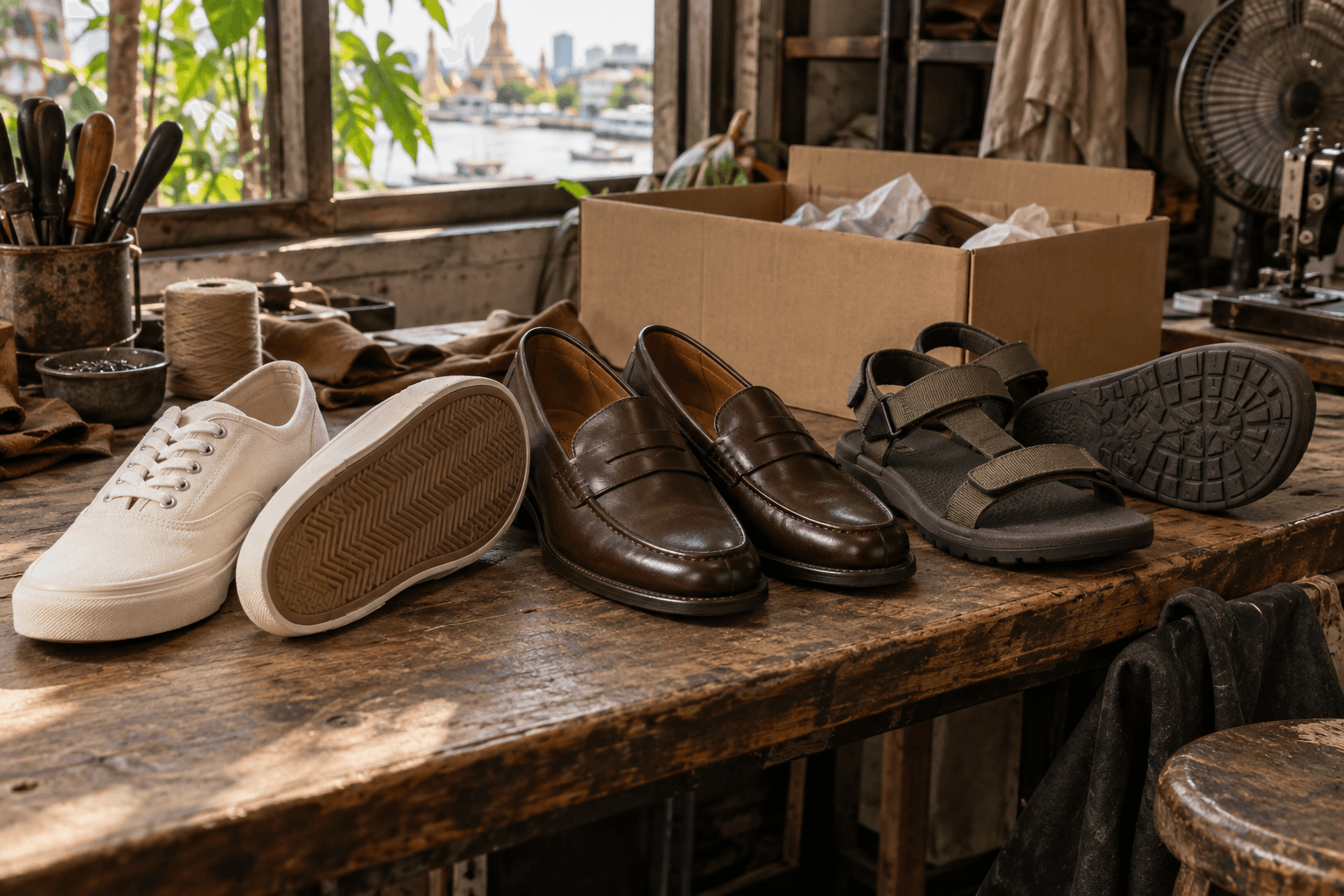
9 percent or 48 percent? Two pairs of shoes with the same price can pay either rate at US customs. The rate is decided by what the upper is made of, what touches the ground, whether the shoe counts as athletic and what one pair is worth. On top of that rate, goods of Thailand pay a 12.5 percent additional tariff, and since August 2025 no parcel is too small to be charged.
Why do two pairs of shoes pay different duty at US customs?
Two pairs of shoes pay different duty because the US tariff schedule sorts footwear by material, construction and value, not by price alone. A textile sneaker, a leather loafer and a cheap canvas trainer can fall under three different lines with rates from 8.5 to 48 percent.
U.S. Customs and Border Protection reduces the whole chapter to two questions:
"Basically, footwear classification in Chapter 64, HTSUS, depends on two factors, the identification of the component material comprising the greatest external surface area of the upper and the external surface area of the outer sole."
Source: What Every Member of the Trade Community Should Know About: Footwear, U.S. Customs and Border Protection.
The upper decides the heading. Rubber or plastics go to heading 6402, leather to 6403, textile to 6404, and anything else to 6405. Inside each heading the sole, the use and the value per pair decide the line.
How does US customs decide what the upper and the sole are made of?
The upper is judged by the material with the largest outside surface, and the sole by the material with the largest surface touching the ground. Trim does not count, so a canvas shoe with leather edging is still a textile shoe.
The rule is written into the notes of Chapter 64 of the Harmonized Tariff Schedule:
"(a) The material of the upper shall be taken to be the constituent material having the greatest external surface area, no account being taken of accessories or reinforcements such as ankle patches, edging, ornamentation, buckles, tabs, eyelet stays or similar attachments; (b) The constituent material of the outer sole shall be taken to be the material having the greatest surface area in contact with the ground, no account being taken of accessories or reinforcements such as spikes, bars, nails, protectors or similar attachments."
Source: Harmonized Tariff Schedule of the United States, Chapter 64, Note 4, U.S. International Trade Commission.
For a Thai seller this means the product description on the invoice has to name the materials. "Shoes, 1 pair" gives the officer nothing to classify, and "women's sandal, synthetic leather upper, rubber sole" gives the line directly. A synthetic leather upper is usually plastics for this purpose, not leather, because the chapter's notes limit "leather" to tanned hides and skins and count a fabric with a visible plastic coating as plastics.
Are ordinary sneakers taxed as athletic footwear?
Yes. A sneaker is classed as athletic footwear for duty purposes whether or not anyone plays sport in it. The tariff schedule defines the category by the shoe, not by its use:
"the term 'tennis shoes, basketball shoes, gym shoes, training shoes and the like' covers athletic footwear other than sports footwear (as defined in subheading note 1 above), whether or not principally used for such athletic games or purposes."
Source: Harmonized Tariff Schedule of the United States, Chapter 64, Additional U.S. Note 2, U.S. International Trade Commission.
CBP lists the features that make a shoe athletic, including foxing bands, athletic tread, a padded tongue and collar, toe bumpers and heel counters, and adds that a shoe "need not exhibit all such features". A lifestyle trainer sold in a Bangkok mall usually has most of them.
How much duty does a pair of shoes pay?
A pair of shoes from Thailand pays the general rate of its tariff line plus the 12.5 percent tariff on goods of Thailand. The general rates run from 8.5 percent on a man's ordinary leather shoe to 48 percent on the cheapest textile and rubber athletic shoes.
Shoe | Upper | Line | General rate |
|---|---|---|---|
Man's ordinary leather shoe | Leather | 6403.99.60 | 8.5% |
Woman's leather shoe, over 2.50 dollars a pair | Leather | 6403.99.90 | 10% |
Sneaker, not athletic, over 12 dollars a pair | Textile | 6404.19.90 | 9% |
Overshoe against water or cold | Textile | 6404.19.20 | 37.5% |
Athletic shoe, not over 3 dollars a pair | Textile | 6404.11.49 or 6404.11.59 | 37.5% or 48% |
Rubber or plastic shoe covering the ankle, not over 3 dollars a pair | Rubber or plastics | 6402.91.60 | 48% |
Source: Harmonized Tariff Schedule of the United States, Chapter 64, Revision 19 (2026), U.S. International Trade Commission.
The additional tariff is 12.5 percent on products of Thailand, collected since 24 July 2026 under a Section 301 action of the Office of the United States Trade Representative. The figure quoted on many pages is out of date: the 19 percent reciprocal tariff of August 2025 stopped being collected on 24 February 2026, after the US Supreme Court ruled that the law behind it did not authorise tariffs. The tariff schedule adds the new rate on top of the general rate, not instead of it:
The duty provided in the applicable subheading + 12.5%
Source: Harmonized Tariff Schedule of the United States, 2026 Revision 20, heading 9903.05.77.
A textile sneaker at 9 percent therefore pays 21.5 percent in total, and a cheap athletic shoe at 48 percent pays 60.5 percent. Trade rules have changed three times in a year, so the rate that applies is the rate on the date of entry.
The low price brackets carry the highest rates. A seller who declares a low value to keep the parcel cheap can push a shoe into the 37.5 or 48 percent lines, which are reserved for the lowest values per pair. The declared value has to be the real price paid.
Do small parcels of shoes still enter the USA duty free?
No. The exemption that let parcels under 800 dollars into the USA without duty was suspended for every country from 29 August 2025. CBP's implementing notice states the consequence:
"Accordingly, all such shipments, except those sent through the international postal network, shall be subject to all applicable duties, taxes, fees, exactions, and charges."
Source: Notice of Implementation of the President's Executive Order 14324, U.S. Customs and Border Protection, Federal Register, 2 September 2025.
For a Thai shop selling one pair at a time to US customers, this is the change that matters. Before the suspension a single pair usually crossed untaxed. Now each pair pays its line and the 12.5 percent, and if the shop ships with a service that does not include duty, the customer receives a bill before the parcel is released. Dragon Courier's USA prices include that duty, so the buyer pays nothing on arrival.
Does a pair of shoes need a "Made in Thailand" label?
Yes. Every imported article must show its country of origin in English, in a place the buyer can see. For footwear that means a mark inside the shoe, and CBP has ruled on where it works. The general rule:
"every article of foreign origin (or its container) imported into the United States shall be marked in a conspicuous place as legibly, indelibly, and permanently as the nature of the article (or container) will permit, in such manner as to indicate to an ultimate purchaser in the United States the English name of the country of origin of the article"
Source: 19 CFR 134.11, Electronic Code of Federal Regulations.
In ruling HQ 732468, CBP accepted a fabric tag stitched under the top third of the tongue or on the inside of the shoe just below the first two lace holes, and rejected a tag halfway down the tongue because it disappears when the shoe is laced.
Shoes are outside the textile fibre labelling rules that apply to clothing, but children's shoes need something clothing buyers rarely think about: a Children's Product Certificate, issued by the importer on the basis of tests at a laboratory accepted by the Consumer Product Safety Commission, under 16 CFR 1110.
About Dragon Courier
Dragon Courier is a Bangkok courier, family owned, with more than 30 years in logistics in Thailand and more than 20,000 shipments a month to over 200 destinations. On the USA route it runs its own service to the USA and clears customs itself, then a US carrier delivers the last leg. The price is duty and tax inclusive, so the 12.5 percent and the tariff line are paid in Bangkok.
Weight | E-commerce | Standard | Express |
|---|---|---|---|
1 kg | 843 | 942 | 1,260 |
2 kg | 1,369 | 1,474 | 1,861 |
5 kg | 2,671 | 2,729 | 3,548 |
Thai Baht, duty and tax included, general price list of 3 August 2026. The e-commerce tier is delivered by UniUni, runs up to 8 kg and cannot be insured. The Standard tier is delivered by UPS and can be insured. The full list and the difference between tiers are in the guide on shipping costs from Thailand to the USA, and the duty on clothing sold with the shoes is in the guide on shipping garments from Thailand to the USA.
Contacts and drop-off
The contents of the box and where it is going are enough to get a quote. Office +66 2656 9019, Justin is on LINE and WhatsApp at +66 6-5937-0812, or info@dragoncourier.com. Drop-off runs until 17:00, Monday to Saturday, at the Bangkok office on Sukhumvit Soi 4 (217/3 Crystal Garden Building, 3rd floor, Klongtoey 10110) or the Chiang Mai office on Viangbua Road, and a pickup can be arranged for a date and time that suits. Is the shoe on the invoice described by its upper and its sole?
How much is the import duty on shoes from Thailand to the USA?
It depends on the shoe. The general rate runs from 8.5 percent on a man's leather shoe to 48 percent on the cheapest athletic shoes, and goods of Thailand add a 12.5 percent tariff on top. On a Dragon Courier shipment both are included in the price paid in Bangkok.
Can I send one pair of shoes to a US customer without duty?
No. The 800 dollar de minimis exemption was suspended for all countries from 29 August 2025, so even one pair pays its duty. With a duty inclusive service the seller pays it in Thailand and the customer receives the parcel without a bill.
Is synthetic leather taxed as leather?
Usually not. The tariff schedule limits "leather" to tanned hides and skins, and a coated fabric with a visible plastic layer counts as plastics. A synthetic leather shoe normally falls under the rubber or plastics heading, which has its own rates, so the invoice should state the real material.
Do I need to put a label inside the shoes?
Yes. Each shoe needs a permanent "Made in Thailand" mark where the buyer can see it. CBP has accepted a tag under the top third of the tongue or inside the side of the shoe below the first lace holes. A tag hidden when the shoe is laced is not accepted.
How do I ship shoes from Bangkok to the USA?
Book with Dragon Courier, describe each style with its upper and sole material and the real price per pair, and drop the box at the Sukhumvit Soi 4 office or arrange a pickup. The price includes duty and tax, and delivery on the USA route takes around 5 to 8 days door to door.
Shipping something from Thailand?
Tell us what you are sending and where it is going, and we will come back to you with a price and a realistic timeline.
Get a quote